
Reflections from My Journey · Yên Tử, Vietnam
I
I came to Yên Tử planning to stay for one day, and within a few hours, I knew that one day wouldn’t be enough.
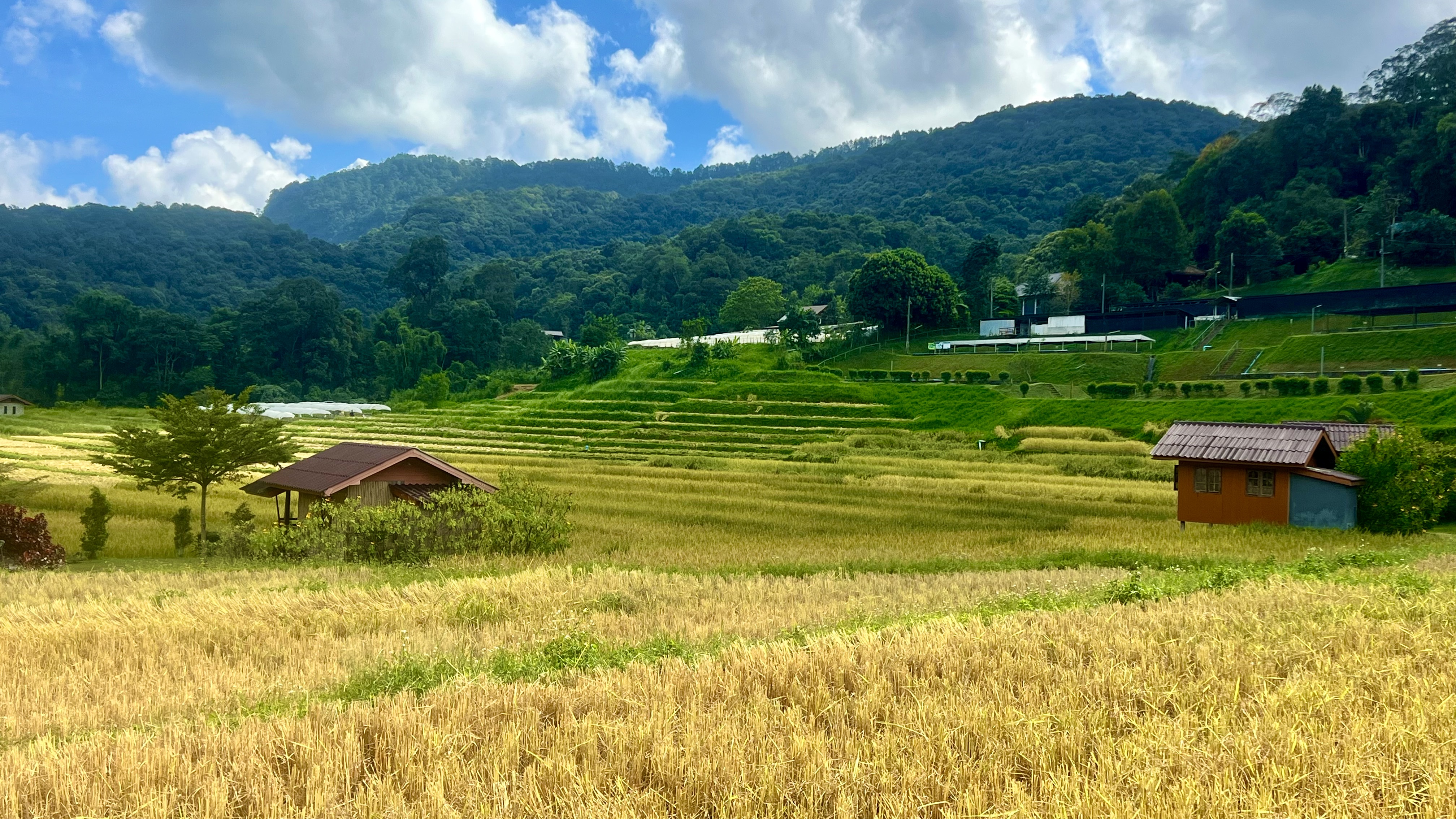
Yên Tử is known as the birthplace of Trúc Lâm Buddhism in Vietnam. The mountain, trees, flowers, water, gardens, and quiet that sounds like music all seem to work together in perfect harmony. Mystical, I would say.
I slowed down without even trying. I wanted to photograph the magnificent scenery, write about it, and capture my feelings. But for a while, I could not.
I was too busy being present with all my senses, inhaling and exhaling as if the entire universe were in my lungs, my heart, and my mind. Walking through the gardens, I paid attention to things I normally might have passed without noticing. I smelled the flowers and the earth. I listened to the water, the birds, and, above all, the silence between their sounds. I practiced Tai Chi, meditation, and yoga. All of it kept my attention on the moment and place; I didn’t want to interrupt the precious experience to record it.
At the mountain’s base is Legacy Yên Tử, designed by architect Bill Bensley and influenced by Vietnam’s 13th-century Trần Dynasty.
When I first arrived, I felt as though I had walked into an ancient monastery. It radiated a stunning and commanding presence. Then I learned about the meaning of the details, and that fascinated me even more.
I became especially interested in the Hall of Sutra Collection, a space that felt to me like a learning hall. What I learned there about wisdom and leadership stayed with me: a future king must first gain wisdom, discipline, humility, and virtue.
I kept thinking about that.
We spend so much time teaching people how to succeed, achieve, compete, and become powerful. But what good is the ability to command others if we have never learned to question ourselves?
And what about learning how to use that power wisely once we have it?
That idea alone kept me in the room for hours. Bensley’s approach fascinated me too.
Before designing Legacy Yên Tử, Mr. Bensley went up the mountain and spent time with the monks. He immersed himself in the history, philosophy, and traditions of Yên Tử, and he brought that learning into the design. Once I understood that, I started looking at everything differently.
The more I learned, the more I admired the care behind the choices. Bensley and the craftspeople made history and philosophy something I could see, touch, and experience.
The image of King Trần Nhân Tông was more than a historical portrait. He was the king who gave up his throne, became a monk, and began the Trúc Lâm tradition at Yên Tử.
His life connected leadership, responsibility, spirituality, and service. I wanted to inhale that wisdom. I wondered what it had meant to step away from a throne. How does a person come to understand that the life he wants requires leaving behind the position others might spend their lives pursuing?
The ten columns were still beautiful, but now I understood them as representations of the Ten Virtues.
The five lanterns did more than illuminate a room. They were part of a larger language of symbols and teachings.
A giant book hanging in the middle of the room caught my attention. It was titled Sutra No Words: a book stripped of words.
It made me think about how knowledge can be right in front of us and still mean very little if we do not put it into practice. We can read hundreds of books, memorize ideas, repeat beautiful quotations, and analyze philosophy in depth.
But has any of it changed who we are and how we live?
I write about awareness, choice, and responsibility, and I believe in them. But believing in patience does not mean I am always patient. Understanding my ego does not mean I always recognize it before I react.
The more I learned about this magnificent space, the hungrier I became to understand it. Even the bronze lotus flowers carried meaning.
The eight petals represented the Buddhist Eightfold Path: right understanding, intention, speech, action, livelihood, effort, mindfulness, and concentration.
I had seen lotus flowers countless times before. Here, I wanted to look again, to move beyond admiring their shape and understand the meaning behind it: purity, spiritual awakening, resilience, and transcendence.
Everywhere I paused to admire beauty, I found something that invited questioning, inspiration, and growth.
The bronze work fascinated me even more when I learned that Vietnamese village artisans have preserved their bronze-making skills over many generations. The walls were made from clay and rice husks, crafted in a style resembling northern Vietnamese houses. The large pottery jars also had a history. In ordinary homes, they once stored rice, grain, and valuables and could represent the prosperity of a household. I loved finding these ordinary things alongside the symbols of kings and Buddhism.
A king mattered, but so did the person making pottery, the hands working with bronze, and the family storing rice for the coming months. I thought about all the people whose names we would never know, whose skills and daily work had helped shape what I was admiring.
It made history feel less like something belonging only to rulers and deities, to palaces and temples, and more like the story of people.
The philosophy of Yên Tử interested me in the same way. Trúc Lâm Buddhism combines Buddhist ideas with Confucian, Taoist, and Vietnamese customs.
The teachings showed me new ways to think about virtue, nature, discipline, responsibility, and how people should live together. The more I understood, the more magnificent the place became.
Normally, we think of beauty as something we see, admire, and appreciate. But here, understanding made things more beautiful and meaningful.
That beauty carried wisdom.
Meaning has always fascinated me. I’m curious about why things exist, what messages people tried to send, what lessons people before us discovered, and whether those lessons still matter today.
Standing in that hall, I kept returning to the idea of preparing a king to lead.
I imagined a king sitting on a throne, being told, “Before you lead others, you must first learn to lead yourself. You must grasp the nature of your own ego. You must learn discipline and reflect on virtue. You must understand that having power and knowing how to use it wisely are two very different things.”
I wondered how often rulers had lived up to such an ideal. Human beings have always been human beings, with many of the same struggles and weaknesses, and power is one of those things that can change us.
The idea led me to a question: What if we expected that of our leaders?
But that question does not belong only to leaders. It belongs to you and me as well.
I ask myself: What do I expect of myself?
I will never rule a kingdom, but every day, I am responsible for something much closer to me: my own life.
I am responsible for my choices, my words, my reactions, and what I do with what happens to me.
I believe an examined life leads to a more meaningful life.
I have influence even without a title. My words and actions can encourage someone or hurt them. I can listen with attention or make another person feel that what they have to say is meaningless. I can choose to admit a mistake or spend my energy defending it. These are ordinary decisions, but someone lives with their consequences, including me.
Knowledge gives me information. Wisdom shows me the way.
That is the difference I kept reflecting on as I walked through Legacy Yên Tử.
Perhaps we do not measure wisdom by how much we know, but by how differently we live because of what we have learned.
That is a much harder test.
It is easy to respect humility in a beautiful hall, but how humble am I when someone tells me I am wrong? It is easy to value kindness when I feel peaceful, but am I kind when I am frustrated, disappointed, or tired?
I could not remain at Yên Tử forever. Eventually, I would return to the conversations, uncertainties, and demands of my life. That was where I would discover what I had really taken with me.
By the time I left the hall, I was no longer just looking at a beautiful place. I felt inspired and challenged; my mind was calm yet alive with questions. I wanted to look more deeply within myself.
What do I understand but still fail to practice?
What do I repeat without examining it, simply because I have heard it many times?
What am I doing with what I have learned?
Maybe that is why Yên Tử touched me so profoundly.
I arrived admiring its beauty, and I discovered the meaning behind that beauty. Somewhere along the way, I realized I had entered a learning hall of my own.
Not as a ruler, but as a woman still learning how to live and what she has to share with the world.
Photograph © Amira Mor