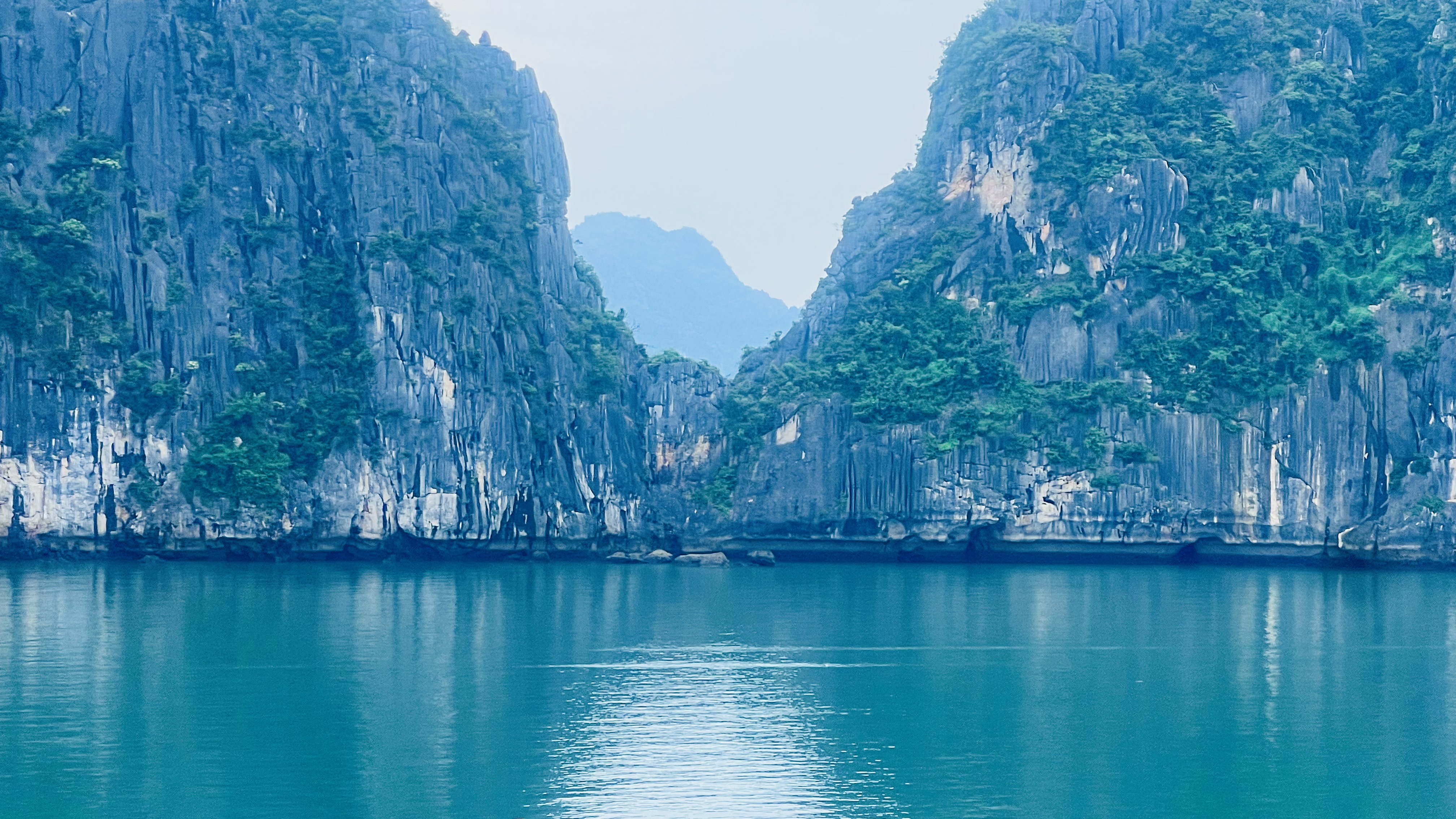

Yên Tử, Vietnam
I came to Yên Tử planning to stay for one day, and within a few hours I knew one day wouldn’t be enough.
I stayed for three.
Yên Tử is known as the birthplace of Trúc Lâm Buddhism in Vietnam, and there is a feeling here that is hard to describe without making it sound more mystical than I mean it to be. The mountain, trees, flowers, water, gardens, and quiet all seem to work together in perfect harmony. I found myself slowing down without even trying.
I wanted to take pictures because everything was so beautiful. I wanted to write about it while I was there so I would not forget what I was feeling.
But for a while I could do neither.
I was too busy being there, simply inhaling and exhaling.
I walked through the gardens and paid attention to things I normally might have passed without noticing. I smelled the flowers and the earth. I listened to water, birds, and mostly complete silence. I practiced Tai Chi, meditation, and yoga. All of it kept bringing my attention back to where I was.
I didn’t want to interrupt the experience in order to document it.
At the foot of the mountain stands Legacy Yên Tử, designed by architect Bill Bensley and inspired by the architecture of Vietnam’s thirteenth-century Trần Dynasty.
When I first arrived, I felt as though I had walked into an ancient monastery.
Then I began learning about what I was actually looking at, and that fascinated me even more.
The beauty was not there simply to be beautiful.
There was meaning behind it.
I became especially interested in the Hall of Sutra Collection, a space that felt to me like a learning hall. What I learned there about wisdom and leadership stayed with me: the idea that before someone becomes a king, he should first learn wisdom, discipline, humility, and virtue.
I kept thinking about that.
We spend so much time teaching people how to succeed, how to achieve, how to compete, and how to become powerful. But what about teaching them what to do with that power once they have it?
That idea alone could have kept me in the room for hours.
Before designing Legacy Yên Tử, Bensley went up the mountain and spent time with the monks. He immersed himself in the history, philosophy, and traditions of Yên Tử, and he brought that learning into the design. Once I understood that, I started looking at everything differently.
The more I learned, the more I admired his ability to bring those teachings into the design. Through the work of Bensley and the craftspeople who helped create this place, history and philosophy became things I could walk among, look at, and feel.
I no longer saw beautiful columns.
I saw ten columns representing the Ten Virtues.
I no longer saw five lanterns simply illuminating a room. They were part of a larger language of symbols and teachings.
The image of King Trần Nhân Tông was not there merely as a historical portrait. He was the king who gave up his throne, became a monk, and founded the Trúc Lâm tradition at Yên Tử. His life connected leadership, responsibility, spirituality, and service. I wanted to inhale that wisdom.
A giant book hanging in the middle of the room caught my attention. It was called Sutra No Words: a book without words. It made me think about how knowledge can be right in front of us and still mean very little if we do not practice it.
We can read hundreds of books. We can memorize ideas. We can repeat beautiful quotations and talk intelligently about philosophy.
But has any of it changed who we are and how we live?
The more I learned about the building, the hungrier I became to understand it.
Even the bronze lotus flowers carried meaning.
The eight petals represented the Buddhist Eightfold Path: right understanding, right intention, right speech, right action, right livelihood, right effort, right mindfulness, and right concentration.
The three layers represented body, speech, and mind and symbolized the Ten Virtues encouraged by King Trần Nhân Tông.
I had seen lotus flowers countless times before.
Here, I wanted to look again, to move beyond admiring their shape and understand what they represented.
And that happened to me over and over at Yên Tử.
Something would first catch my eye because it was beautiful, and then I would learn why it was there.
The bronze work interested me for another reason. Pieces were made by craftspeople from Vietnamese villages where bronze-working traditions have been passed down through generations.
Then I learned about the unique wall design, made using materials such as clay and rice husk in ways that recalled traditional northern Vietnamese homes.
The large pottery jars also had a history. In ordinary homes, they once stored rice, grain, and valuables and could represent the prosperity of a household.
I loved finding these ordinary things alongside the symbols of kings and Buddhism.
A king mattered.
But so did the person making pottery.
So did the hands working with bronze.
So did the family storing rice for the coming months.
So did the materials people took from the earth to build a home.
It made the history feel less like something belonging only to rulers and temples and more like the story of people.
The philosophy of Yên Tử interested me in the same way. Trúc Lâm Buddhism developed here by bringing Buddhist thought together with ideas from Confucianism, Taoism, and Vietnamese traditions.
I loved that too.
There was not only one way of looking at life represented around me. Different traditions had contributed different ideas about virtue, nature, discipline, responsibility, awareness, and how human beings should live together.
The more I understood, the more magnificent the place became.
That surprised me.
Normally we think of beauty as something we see, admire, and appreciate. But here, understanding made things more beautiful and meaningful. That beauty was carrying wisdom.
That may be what touched me most deeply about Yên Tử.
I have always been fascinated by meaning. I want to know why something exists, what someone was trying to communicate, what people before us learned about life, and whether any of that wisdom still has something to teach us now.
And standing in that hall, I kept returning to the idea of preparing a king to lead.
Imagine being told before you are allowed to lead others that first you must learn to lead yourself.
You must understand your own ego. You must learn discipline and think about virtue.
You must understand that having power and knowing how to use it wisely are two very different things.
I wondered how often rulers had lived up to such an ideal. Human beings have always been human beings, and power is one of those things that can change us.
But I was deeply touched by the ideal itself.
What if we expected that of our leaders?
And I know that the question does not belong only to leaders.
It belongs to you and me too.
I may never rule a kingdom, but every day I am responsible for something much closer to me: my own life.
I am responsible for my choices, my words, my reactions, and what I do with what happens to me.
Knowledge can give me information. Wisdom shows me the way.
I believe an examined life leads to a more meaningful life.
That is the difference I kept thinking about as I walked through Legacy Yên Tử.
Perhaps wisdom is not measured by how much we know, but by how differently we live because of what we have learned.
That is a much harder test.
By the time I left the hall, I was no longer simply looking at a beautiful place.
I felt lifted in body and heart, and my mind was calm yet alive with questions. I wanted to look more deeply within myself.
What do I understand but still fail to practice?
What do I repeat because I have heard it many times without really examining it?
What am I doing with what I have learned?
Maybe that is why Yên Tử touched me so deeply.
I arrived admiring its beauty.
Then I discovered the meaning inside the beauty.
And somewhere along the way, I realized that I had entered a learning hall of my own.
Not as a king.
Just as a woman still learning how to live and share her life wisely.