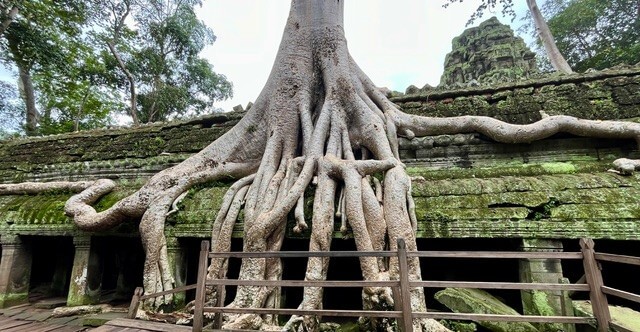
At Ta Prohm, I could not always tell whether I was looking at trees or ancient animals. Roots twisted like snakes around the ancient stones. It was so magnificent and unreal that, at first, I thought an artist had created it. Then I realized what nature had done.
No artist can compete with Mother Nature.
People had built a spectacular temple centuries ago, but the trees would not allow it to remain only a temple. They grew from the rooftops, entered the spaces between the stones, and wrapped themselves around, under, and over what human hands had created. In this extraordinary chaos, I saw the most unbelievable beauty.
Yet some of the beauty I admired was also destroying the temple. To me, it looked like a struggle between human creation and nature. Nature didnt aim to destroy; the trees were just trying to survive.
Walking among the temples of Angkor, I admired what people had created and wondered about the lives spent building it. Had this work been their life’s purpose? What had moved them? Devotion? Love? Fear? A king’s ambition? The hope that something they built would remain long after they were gone?
I ask similar questions when I visit churches, synagogues, and mosques. I am fascinated by humans’ need to worship. Here, I thought about Hinduism and Buddhism, about sacred places changing hands, about people claiming that their faith held the truth and another person’s did not.
How easily the desire to honor God can become the desire to prove that our God is greater.
And I wondered: Is God our ego?
I cannot know what God is, or what another person experiences in prayer. But I can question what we do in God’s name.
Perhaps the danger begins when our ego believes it speaks for God.
Devotion can be beautiful. But when belonging to a faith makes us feel superior to someone outside it, what are we devoted to? When defending our beliefs becomes permission to harm another person, what exactly are we protecting?
Around me were sacred serpents carved in stone, the nāga, associated with protection. At East Mebon, stone elephants stood at the four corners of the temple. And I thought, we honor elephants in monuments, yet abuse them for entertainment. We admire animals carved in stone while turning away from the suffering of animals raised and killed for our food.
How do we decide which life deserves reverence and which life we may use?
I was angry.
We build temples and then kill one another. We pray for peace and find reasons to excuse violence. We speak of compassion while making exceptions for our hunger, our pleasure, our convenience.
What does our devotion mean if it does not change how we treat life?
I wanted to ask how people could fail to see the contradiction. I called it hypocrisy.
Then I thought about myself. I had probably killed twenty mosquitoes just standing there. They love me much more than I love them.
That stopped me for a moment. Where do I draw the line? Where does a life become inconvenient? Where it bites?
I still felt angry. But now I had a question for myself too.
The trees and beauty kept drawing my attention back.
Their roots crossed the stones without regard for the god once honored there. They did not know which kingdom had ruled or whose beliefs had prevailed. These temples had outlived the people who built them. Even the stone could not stay as they had left it.
People had carved serpents into their temples. Now living roots curled around them in shapes that reminded me of those same creatures. I could hardly tell where the human imagination ended, and nature began.
I understood the longing for comfort and belonging, for some reassurance that our lives and our losses mean something. I would not take that comfort from anyone.
Perhaps God was never contained inside the temple. Perhaps someone standing beside me would find God in everything I was seeing.
But whatever we believe, there is life here, now.
Why is caring for it so much harder than worshipping what we believe created it?
Why do we need something greater than life to make life matter?
Isn’t it enough that we are here?