Nha Trang is a spectacular blend of color, scent, flavor, heat, nature, and movement.
Cars, motorbikes, and pedestrians flow from every direction, weaving around one another with a confidence that, to me, seemed wildly dangerous.
From where I stood, it looked like chaos.
Crossing the street felt like stepping into a moving river and trusting the water to part around me. There appeared to be no rules, no hesitation, and no fear.
It was like dancing on the edge of a cliff.
And yet, somehow, no one collided.
Everyone seemed to know when to move, when to slow down, and when to make room for someone else. What looked dangerous to me was natural to them. They were not fighting the movement. They were moving with it.
Perhaps that is what harmony sometimes looks like. Not perfect order. Not stillness. Not control. Harmony can also be a thousand moving parts responding to one another without needing to be told how.
The people of Vietnam seemed to understand this dance.
I saw it again at the market.
The market was a feast for the senses. Brilliant colors competed for my attention. Voices rose above one another. The scents of food, fruit, spices, and daily life filled the air. Vendors called out. Customers negotiated. Money passed from one hand to another. People moved through narrow spaces carrying bags, baskets, and children.
Everything was happening at once.
And still, it worked.
The bargaining did not feel like conflict. It felt like communication. Each person seemed to understand that the final price would be found somewhere between what was asked and what was offered.
No one needed to win completely.
Perhaps harmony is created not when everyone gets exactly what they want, but when people remain willing to meet somewhere in the middle.
Later, I entered the cathedral.
Outside, the city continued rushing past. Inside, the world became quieter.
The soaring arches, luminous stained glass, and imposing stone walls drew my eyes upward. Beauty surrounded me, but so did something less visible: the faith of all those who had entered before me carrying their prayers, their sorrow, their gratitude, and their hope.
For centuries, human beings have created magnificent sacred places in an attempt to reach toward something greater than themselves. We raise towers toward the heavens. We carve statues, build altars, and transform light into color because we long to give form to what cannot be seen.
Standing beneath such beauty, it is difficult not to feel awe.
But I also wondered whether God truly needs a building in order to be found.
Perhaps sacred places do not contain God. Perhaps their beauty simply makes us quiet enough to notice what has always been present.
At Long Son Pagoda, I climbed toward the great white Buddha.
The higher I climbed, the farther the city seemed to fall beneath me. Then I saw him, immense, luminous, and serene against the open sky.
For a moment, I could only stand and look.
Below, the city continued moving, sounding its horns and carrying people toward wherever they believed they needed to go. Above it all, the Buddha sat in complete stillness, almost smiling.
Movement below.
Stillness above.
I had come searching for peace that day, but standing before the Buddha, I began to wonder whether peace was something I needed to search for at all.
The Buddha was not reaching for anything. He was not trying to escape the chaos below. He was simply present.
Perhaps peace is not found by removing ourselves from the noise of life. Perhaps it arrives when the noise no longer controls what is happening within us.
And maybe God is the same.
We search in churches, temples, books, teachers, and distant places. We climb steps and cross oceans hoping to encounter something sacred. Yet perhaps God is not sitting high above us, waiting to be found.
Is it possible that we are too busy searching to notice?
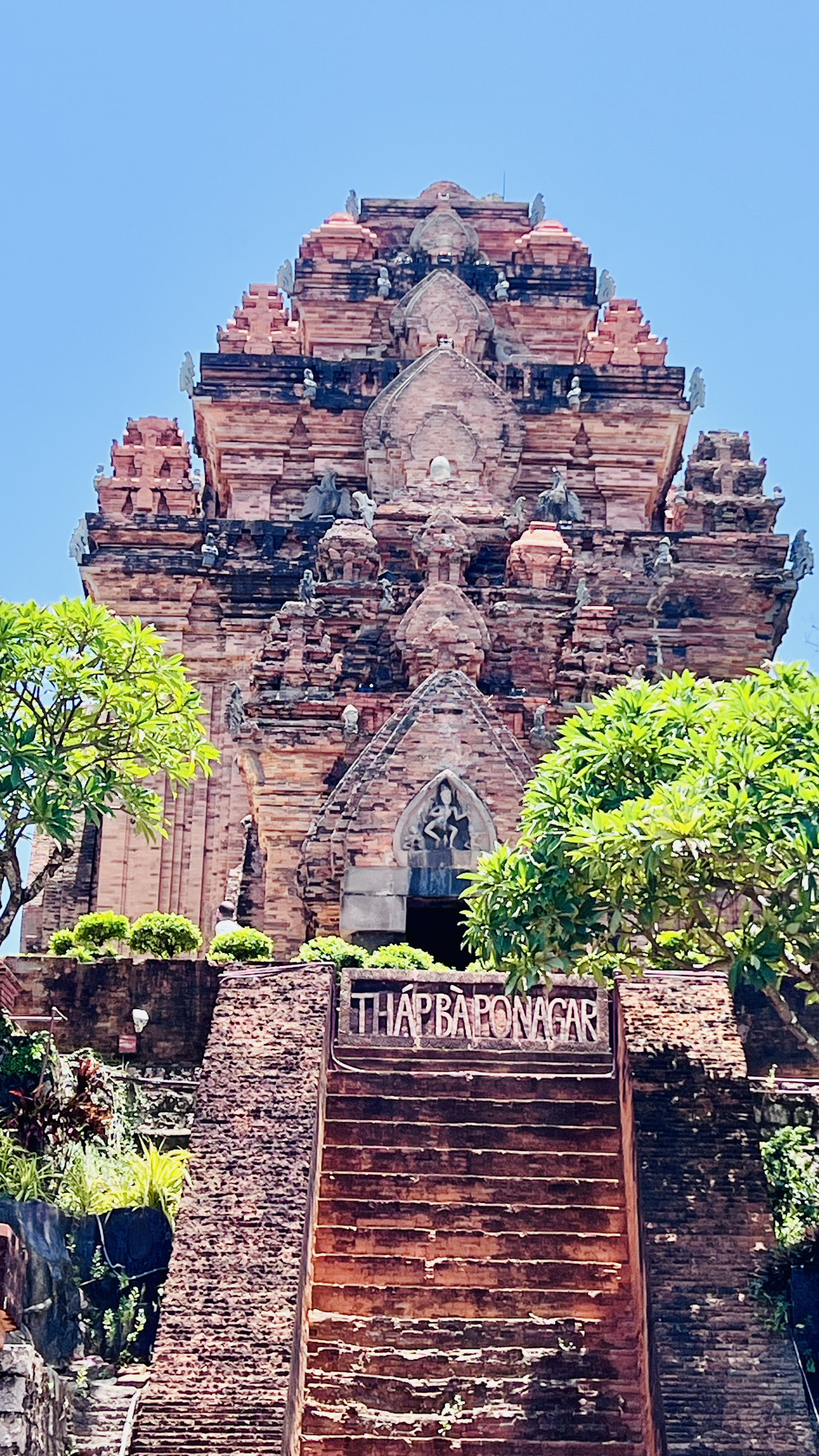
Then I arrived at Po Nagar.
The ancient red-brick towers rose before me with a beauty that felt almost impossible to describe. Weathered by centuries and still standing, they seemed to carry time within them. Every carving, every arch, and every stone revealed the extraordinary imagination and devotion of the people who had created them.
I had expected the magnificent red towers to feel fiery and severe. Instead, they felt warm, safe, and inviting. Almost maternal.
Only afterward did I learn that Po Nagar was built by the Cham people in honor of their Mother Goddess. Perhaps that was why I felt her presence long before I knew her story.
The towers rose with strength, but they did not make me feel small.
They seemed to welcome me.
This was not the untouchable divine.
This was the welcoming mother.
I was awed by the beauty Hinduism had inspired. There was something sacred not only in the towers themselves, but in the human capacity to imagine such beauty and then bring it into existence.
Po Nagar did not merely make me look upward. It seemed to reach downward and gather me in.
In that moment, I did not feel as though I were standing before an unreachable God or Goddess.
I felt embraced.
Different religions may use different names, symbols, rituals, and stories. Yet beneath them may live the same human longing: to feel protected, to find meaning, to understand our place in the universe, and to know that we are not alone.
By the end of the day, I understood that Nha Trang had been revealing the same truth in many different forms.
In the traffic, movement became a dance.
In the market, negotiation became harmony.
In the cathedral, beauty lifted my eyes toward God.
Before the Buddha, stillness brought me back to myself.
And at Po Nagar, the sacred welcomed me home.
What first appeared to be a city of contradictions was perhaps a city of balance.
Movement and stillness.
Noise and silence.
Strength and tenderness.
The sacred and the ordinary.
Perhaps they were never opposites.
We often believe peace will arrive when life becomes quiet, when uncertainty ends, when everyone agrees, or when the world finally moves according to our plans.
But life does not remain still.
It rushes around us like the streets of Nha Trang. It asks us to climb, to question, to trust, and sometimes to step forward even when we cannot see how the path will open.
Perhaps peace does not come when the movement stops.
Perhaps peace is learning how to dance within it.