There are places in the world we do not merely see.
Somehow, they enter our souls.
Husband Island, Hòn Chồng, entered mine.
It was one of the most beautiful places I had ever seen. And somehow, I discovered it at the moment I needed it most.
From the moment I saw it, I felt as though I had stepped into a love story written by nature long before human beings found words for love.
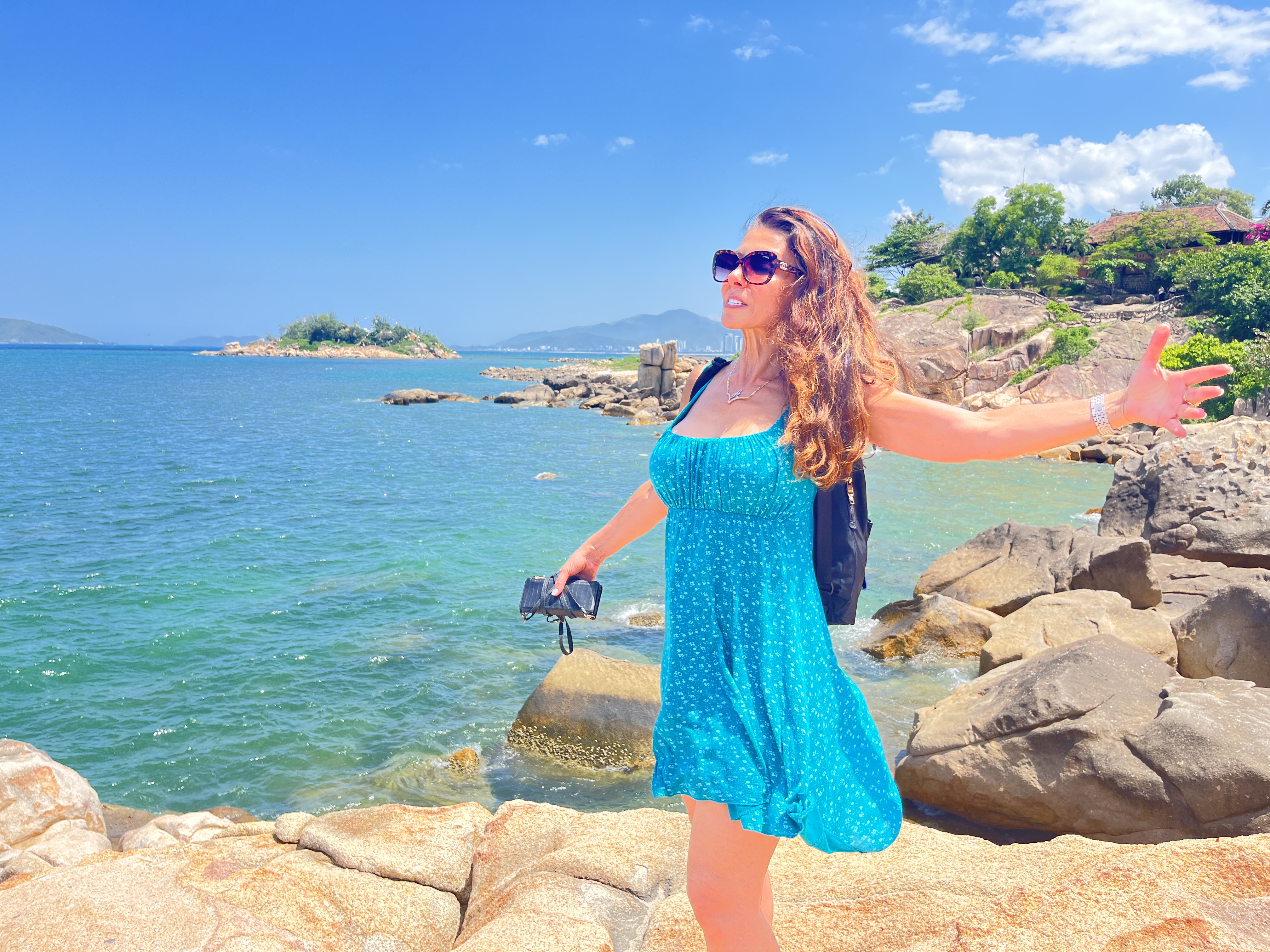
Before me, enormous rocks rose from the edge of the sea, resting upon one another in ways that seemed to defy reason. Some leaned. Some balanced. Some reached outward toward the water. Others remained firmly planted, as though nothing in the world could move them.
They lay together in a way only Mother Nature could create.
They appeared powerful enough to withstand eternity, yet the water touched them with such tenderness.
The sea became a musical instrument, rushing forward and pulling away.
Again and again.
It did not try to conquer the rocks. The rocks did not attempt to contain the sea.
One moved.
The other remained.
And somehow, neither was diminished by the other.
I stood before them in awe.
My body stood still.
My heart moved in waves of astonishment and admiration.
The blue of the sea seemed to stretch into the sky until I could no longer see where one ended and the other began. Mountains rose in the distance. Islands rested upon the horizon. Sunlight danced across the water, turning each wave into a brief shimmer of silver.
Everywhere I looked, strength was softened by beauty.
The rocks were immense and ancient, yet flowers and green leaves found places to grow between them. The sea was restless, yet peaceful. The mountains appeared solid, yet the mist made them seem almost weightless.
Nothing competed for attention.
Everything belonged.
This was not balance created through control. It was not symmetry or perfection. The rocks were irregular. The waves arrived unevenly. The mountains rose at different heights.
And still, together, they created something magnificent.
Perhaps true balance does not require things to be equal.
Perhaps it asks only that everything be allowed to become fully what it is.
And I wanted only to be.
Nearby is Hòn Vợ, Wife Rock. Local legends connect the two formations through devotion, a husband and wife facing the sea together through every storm.
I do not know which version of the legend is true.
But standing there, I understood why people needed to create a love story for this place.
Love was already everywhere.
It lived in the way the water returned to the shore no matter how many times it was sent away.
It lived in the way the rocks received every wave without asking it to become still.
It lived in the mountains watching silently from a distance.
It lived in the small green plants growing from the hardest stone.
And it lived in the space between all of them, where nothing needed to change in order to belong.
We often imagine love as two people becoming one. We praise those who think alike, move alike, and want the same things.
But the sea does not become the rock.
The rock does not become the sea.
Their beauty exists because they remain different.
They remain true to themselves.
One is fluid.
One is solid.
One speaks in waves.
One answers with silence.
One knows how to move.
The other knows how to stay.
Maybe love is not found in becoming the same.
Maybe it is found in standing beside another without asking them to surrender their nature.
As I looked at Hòn Chồng, I thought about how often we disturb the balance of our lives by trying to control what was never meant to be controlled. We resist movement when life asks us to flow. We keep moving when life asks us to be still. We hold on to people who need freedom, and sometimes abandon those who simply need us to remain.
But nature does not struggle to decide what it should be.
The sea moves.
The stone stays.
The trees bend.
The mountains rise.
And together, they create harmony.
Perhaps that was why I loved this place so deeply.
I was not merely looking at beauty.
I was looking at belonging.
Nothing stood alone, yet nothing lost itself.
For a while, I forgot the world beyond that shore. I forgot uncertainty, questions, and everything still waiting to be decided. I wanted only to remain there, surrounded by a beauty so complete that it asked nothing of me except to see it.
And I did.
I looked at the rocks and wondered how many storms they had endured.
I watched the waves and wondered how many times they had returned.
I looked toward the distant mountains and felt the quiet presence of something eternal.
At Hòn Chồng, I did not need to search for peace.
I did not need to understand God.
I did not need to ask life for an answer.
For one extraordinary moment, everything was exactly where it belonged.
The sea.
The stone.
The mountains.
The sky.
And me.
Perhaps the greatest love stories are not about finding someone who completes us.
Perhaps they are about discovering a love spacious enough to let us remain whole.
At Hòn Chồng, the sea did not complete the stone.
The stone did not complete the sea.
They simply met at the edge of the world and made one another more beautiful.